How Ford Commercial Vehicles Support Broken Arrow Businesses
Quick Answer: How do I choose the right Ford commercial vehicle for my business?
Start with the work, not the truck. Add up what you actually haul and tow on a normal day, decide how many people ride along, and confirm whether you need an enclosed, secure cargo area or an open bed. Those three answers narrow the lineup quickly.
The F-150 fits light-duty service work and businesses that mix personal and business use, where towing stays modest and the truck also has to be comfortable off the clock. F-250 and F-350 Super Duty trucks are the answer when you tow equipment trailers, carry heavy material, or run a plow, and they support the payload and towing margins that lighter trucks cannot. Chassis cabs exist to receive a body, so they suit any business that needs a service body, flatbed, dump bed, or box: utility crews, construction, and landscaping. Transit cargo vans are built for delivery, courier, and trade work where tools and inventory need to stay locked, dry, and organized, and Transit passenger vans move crews, shuttle riders, and nonprofit groups.
Most growing businesses end up with a mix. The right approach is to size each unit to a specific job rather than buying one vehicle and hoping it covers everything. Confirm payload and towing numbers against real weights before you order, and plan the upfit at the same time you spec the chassis.
Matching Your Work to a Ford Model
| Business Need | Recommended Ford Model |
|---|---|
| Light-duty service | F-150 |
| Heavy towing | F-250 / F-350 Super Duty |
| Utility / service body | Chassis Cab |
| Delivery / cargo | Transit Cargo Van |
| Passenger transport | Transit Passenger Van |
| Mixed fleet | Combination, spec'd per role |
Availability and configurations change by model year. Browse our currentfleet and commercial inventory or review the fullFord Pro commercial lineup to see what is offered right now.
Ford commercial vehicles are built to work, and for many businesses in and around Broken Arrow, the right work truck or van can make daily operations smoother and more profitable. The main question we hear is simple: how do you choose and use the right Ford commercial vehicle so it actually fits the way your team works?
When we talk about Ford commercial vehicles, we are usually referring to Super Duty pickups like F-250 and F-350, chassis cab trucks that receive specialty bodies, Transit cargo and passenger vans, and cutaway models that become box trucks, shuttles, or service bodies.
These vehicles are commonly used by contractors, HVAC and electrical crews, landscapers, delivery services, municipal departments, nonprofits, and small businesses that need dependable transportation every day. In this article, we will walk through model differences, upfit options, costs and financing basics, and how to match the right Ford work vehicle to your real-world needs in the Tulsa and Broken Arrow area.
Deciding If You Need a Ford Commercial Vehicle
Not every business needs a dedicated commercial unit. Sometimes a personal pickup or SUV is enough. The tipping point usually comes when daily work starts pushing the limits of comfort, capacity, or professionalism.
A commercial vehicle often makes sense if:
- You regularly haul heavy materials or tow equipment
- You are on the road every workday, visiting job sites or customers
- Your tools and inventory need secure, organized storage
- You want rolling advertising with your logo and contact information
- You are looking at potential business tax write-offs for vehicles
Before shopping, it helps to clarify how the vehicle will be used day to day. Ask yourself what you haul most often and how heavy it is, how often you tow and what type of trailer you use, whether your routes are mostly city streets, highway miles, or job sites, how many people ride in the vehicle on a normal day, and whether you need features like ladder racks, enclosed storage, or a service body.
Owning a dedicated work vehicle has clear advantages, such as a more professional image at customer locations, better organization of parts and tools, and a vehicle that is built to take the daily abuse of work. The tradeoff is a higher upfront cost compared to simply using an existing personal vehicle. There can be tax advantages to business vehicles, but it is always important to talk with a qualified tax professional about your specific situation.
Core Ford Commercial Models and What They Do Best
Ford's commercial lineup covers a wide range of jobs, from small local services to larger fleets. While specific availability changes over time, there are a few core categories that consistently answer most business needs.
Common choices include:
- F-150 for light-duty work and mixed personal and business use
- F-250 and F-350 Super Duty for heavier towing and payload
- Chassis cab trucks for service bodies, flatbeds, and box bodies
- Transit vans for enclosed cargo or passenger duty
Different business types tend to align with different platforms. Trades like plumbing, electrical, and HVAC often pair well with Super Duty pickups or vans outfitted with shelving and racks. Construction crews may lean toward Super Duty or chassis cabs with flatbeds, dump beds, or service bodies. Landscaping companies usually need open or enclosed trailers pulled by Super Duty trucks, or chassis cabs with landscape bodies. Delivery and courier services typically favor cargo vans or box-style cutaways for secure, easy-to-load cargo. Municipal and nonprofit fleets may mix pickups, vans, and specialty units depending on their programs.
When you compare models, a few practical differences tend to matter the most:
- Cab configurations: regular cab, extended and crew cabs for extra passengers or for interior storage
- Wheelbase options: shorter for tighter city driving, longer for stability and body upfits
- Towing and payload ranges: each model has a specific capacity, so matching numbers to your work is important
- Drivetrains and upfit-friendly features: available 4x2 or 4x4, flat frame rails on chassis cabs, power take-off (PTO) availability where offered, and factory prep packages that make upfitting smoother
Matching Towing, Payload, and Power to Real Work Needs
Some of the most confusing terms in commercial vehicles are towing, payload, GVWR (gross vehicle weight rating), and GCWR (gross combined weight rating). In simple terms:
- Payload is how much weight the vehicle can carry in the cab and bed or cargo area.
- Towing capacity is how much the vehicle can safely pull behind it.
- GVWR is the maximum legal weight of the loaded vehicle.
- GCWR is the maximum legal weight of the loaded vehicle plus the weight of any trailer and its load.
Overloading can affect handling, braking, tire life, safety, and potentiallywarranty coverage, so it pays to size the truck correctly.
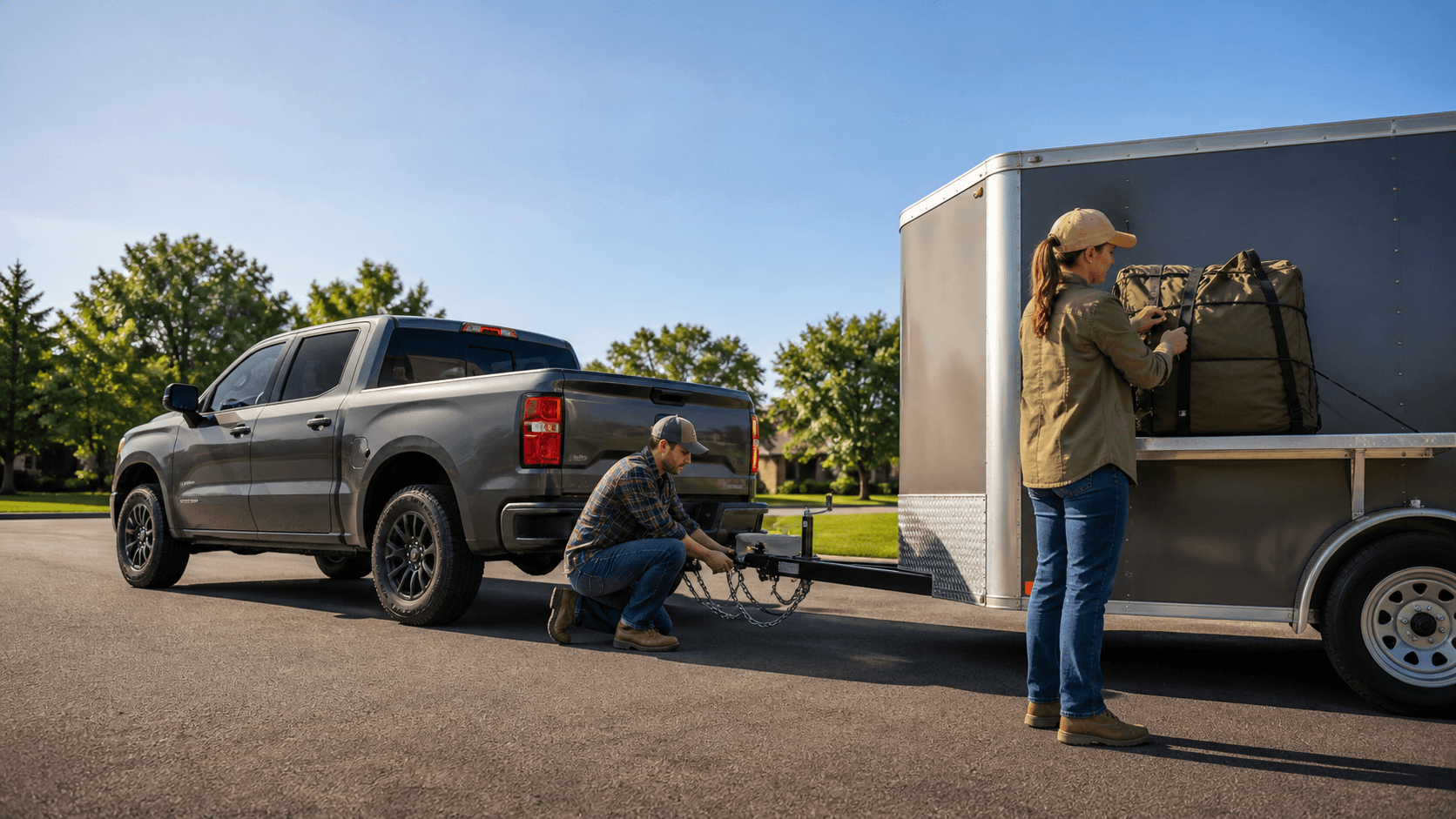
Here is a quick example that fits what we often see in our area. Say you are a Broken Arrow contractor: you tow a trailer with a small skid steer and attachments several times a week, the loaded trailer weighs a few thousand pounds, and you also carry tools, a toolbox, materials, and maybe a generator in the truck bed.
To size the truck, you would:
- Estimate the fully loaded trailer weight, not just the empty trailer.
- Estimate the total weight of tools and materials in the truck.
- Confirm that the truck's tow rating covers the trailer weight with some margin.
- Confirm that the payload rating covers tongue weight plus people and cargo in the truck.
Engine choice, axle ratio, and 4x2 versus 4x4 also matter. For mostly paved, in-town routes with light towing, a lighter-duty truck with 4x2 may be enough. For construction zones, rural properties, unpaved lots, and wet or icy conditions that show up in Oklahoma weather, many businesses appreciate the added traction of 4x4. A higher axle ratio can help with heavy towing, while a lower ratio may favor fuel economy on highway-dominant routes. Ourresearch hub has model-by-model capability details if you want to compare configurations before you visit.
Upfitting, Branding, and Fleet Planning in Broken Arrow
Upfitting is the process of adding work-specific equipment to your truck or van. For trades and service businesses, this is often what turns a basic vehicle into a real mobile workstation.
Common upfits include:
- Shelving, drawer systems, and partitions for vans
- Ladder and material racks for trucks and vans
- Service bodies with exterior compartments for tools and parts
- Flatbeds, dump bodies, or box bodies on chassis cabs
- Additional lighting, power inverters, and custom electrical work
Working with a commercial-focused dealership can help coordinate between the Ford chassis and local or regional upfitters. The goal is to order a vehicle with the right wheelbase, GVWR, cab style, and prep packages so the planned body or equipment can be installed correctly. Getting those specs right at the start is much easier than trying to work around a mismatch later.
Ford publishes technical resources for this process throughFord Pro Upfit and theBody Builder Advisory Service (BBAS), includingBody Builder Layout Books and upfitter publications that specify frame dimensions, electrical provisions, and clearances. If your upfitter asks for those documents, that is a good sign they are doing the job properly.
As your business grows, planning your fleet pays off. A few strategies that consistently help are standardizing on a few models and specs so drivers and techs can move between units easily, keeping consistent maintenance schedules and records to track costs and downtime, and using consistent branding with wraps or decals so your trucks and vans are recognizable across Broken Arrow, Tulsa, and nearby communities.
Total Cost, Financing, and Service Considerations
Sticker price is only part of what a work vehicle really costs. Total cost of ownership usually includes:
- Fuel and fluids
- Insurance
- Scheduled maintenance items like oil changes, filters, brakes, and tires
- Unscheduled repairs
- Downtime when the vehicle is off the road
- Potential tax benefits, which should always be reviewed with a tax professional
Commercial financing and leasing have their own considerations. Approval and terms typically depend on factors like credit profile, business history, down payment, and how the vehicle will be used. Business lines of credit or fleet accounts work differently than personal auto loans, especially when multiple vehicles are involved or annual mileage is high. Ford's commercial financing runs throughFord Pro FinSimple, which offers commercial installment financing, commercial leasing, and aCommercial Line of Credit that lets approved businesses add vehicles without reapplying each time. Ourfinance department can walk you through which structure fits your situation, and you can start acredit application or estimate numbers with ourpayment calculator before you come in.
A dedicated Ford commercial service department plays a big role in keeping your business moving. Benefits can include:
- Technicians familiar with Ford commercial platforms and common work-related wear issues
- Access to Ford Genuine Parts
- Service processes designed around uptime, so your vehicles spend more time working and less time waiting
- Preventive maintenance plans that help catch small issues before they become expensive breakdowns
At Jim Norton Ford, commercial customers can use ourcommercial Quick Lane for routine service without an appointment,Ford Pickup and Delivery andmobile service to keep trucks working,commercial tire service, anddiesel service specials for Power Stroke fleets. Extended coverage is available throughFord Protect if you want costs more predictable beyond the factory warranty period.
Common Mistakes to Avoid
- Buying based only on price. The cheapest unit on the lot is rarely the cheapest over five years. A truck that is slightly undersized for your work will burn through brakes, tires, and suspension components faster, spend more days in the shop, and cost you revenue every time it is down. Compare the total cost of the configuration you actually need, including the upfit, rather than the entry price of a configuration you will outgrow.
- Underestimating payload. Payload is consumed faster than most buyers expect. Passengers, a full fuel tank, a toolbox, a service body, ladder racks, and trailer tongue weight all draw from the same number. Two crew members and a loaded service body can absorb most of a light-duty truck's payload before you have added a single piece of material. Weigh your typical load rather than estimating it.
- Ignoring upfit requirements. The body dictates the chassis, not the other way around. Wheelbase, cab-to-axle dimension, GVWR, frame configuration, and electrical prep packages all have to be correct at the time of order. Discovering after delivery that your dump body needs a different cab-to-axle measurement is an expensive and slow problem to fix.
- Not planning for future growth. Businesses tend to spec for today's workload and then take on bigger jobs within a year or two. If you are trending toward heavier trailers, more crew, or additional equipment, a small step up in capability at purchase is far cheaper than replacing the vehicle early. Standardizing specs also makes it easier to add matching units later.
- Confusing towing with payload. These are separate ratings and hitting either one is a problem. A truck rated to tow 20,000 pounds may still be limited by how much weight it can carry in the bed and cab, and trailer tongue weight counts against payload rather than towing. Check both numbers against your real loads, and remember GCWR limits the combined total.
Next Steps to Choose the Right Ford Work Vehicle
Before you visit a dealership, it helps to narrow down a few decisions:
- Your primary use case: service calls, hauling materials, deliveries, or mixed use
- Required towing and payload, based on real weights, not guesses
- Passenger needs, including whether crew members need to ride together
- Preferred body style or upfit, like service body, flatbed, or shelved cargo van
- A realistic budget range that includes upfits and operating costs, not just the base truck
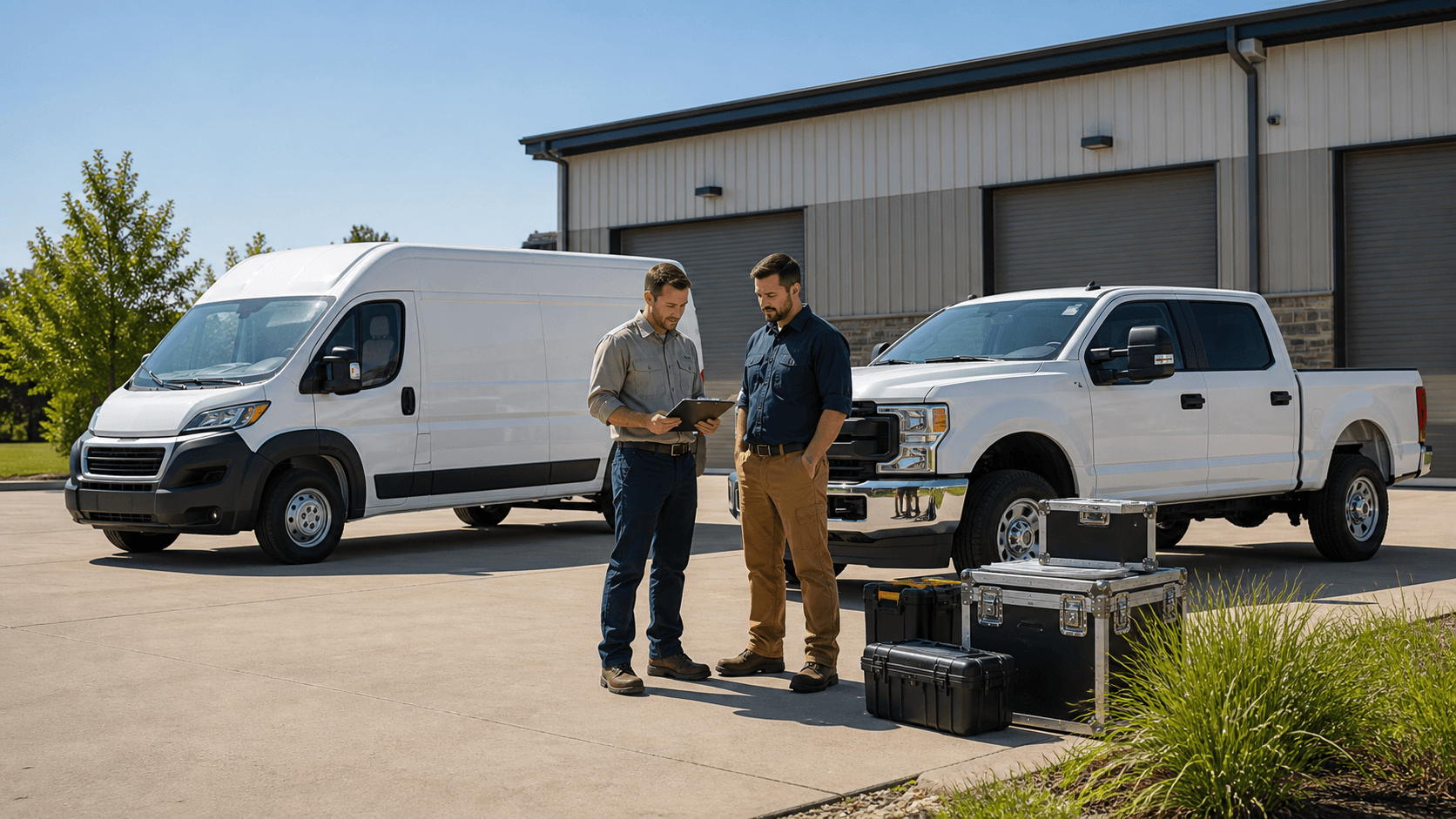
One of the most productive things you can bring to a commercial appointment is a "day in the life" description of how your ideal vehicle would work. When we know how far you drive, what you carry, where you park, and what slows you down now, we can point you toward specific Ford models, trims, and packages that match those details. With the right planning, a Ford commercial vehicle can become a reliable tool that supports your current workload and leaves room for future growth.
Frequently Asked Questions About Ford Commercial Vehicles
Which Ford is best for my business? It depends on load, crew size, and whether cargo needs to be enclosed. Light-duty service work and mixed personal use point to the F-150. Heavy trailers, plows, and heavy material point to F-250 or F-350 Super Duty. A service body, flatbed, dump bed, or box body requires a chassis cab. Secure tools and inventory point to a Transit cargo van, and moving crews or riders points to a Transit passenger van. Bring your real weights and route details and we can narrow it to specific configurations.
Should I buy or lease a commercial vehicle? Buying suits businesses that keep vehicles well past the payoff, run high annual mileage, or plan permanent upfits like a welded service body. Leasing suits businesses that want predictable payments, cycle vehicles on a schedule, or want to preserve capital for other equipment. Mileage and condition terms matter more on commercial leases than most buyers expect, and heavy upfits complicate returns. Ford Pro FinSimple offers both commercial installment financing and commercial lease products, so the decision is usually about cash flow and how long you keep vehicles.
Should I finance through Ford Credit?
Ford's commercial financing now operates asFord Pro FinSimple, the commercial arm of Ford Credit. Its advantage for fleets is a Commercial Line of Credit, which lets an approved business add vehicles throughout the year without a new application each time, plus the ability to finance the upfit along with the chassis. Whether it beats your bank depends on your rates and relationship, so it is worth comparing. Our finance team can run the Ford Pro FinSimple numbers alongside whatever else you are considering.
What is GVWR vs. payload?
GVWR is the maximum legal weight of the fully loaded vehicle, including the vehicle itself, fuel, passengers, cargo, upfit equipment, and trailer tongue weight. Payload is what is left over for everything you add: GVWR minus the vehicle's curb weight. So GVWR is a ceiling, and payload is your usable capacity beneath it. Adding a heavy service body reduces payload without changing GVWR, which is why upfitted trucks often have far less remaining capacity than the base spec sheet suggests.
What is the difference between towing capacity and payload?
Towing capacity is what the vehicle can pull behind it. Payload is what it can carry on board. They are separate limits and both can be exceeded independently. The connection people miss is trailer tongue weight, typically 10 to 15 percent of the loaded trailer, which counts against payload rather than towing. GCWR then caps the combined weight of truck and trailer together, so a truck can be within its tow rating and still be illegally loaded.
What upfits are available?
Common upfits include van shelving, drawer systems and partitions, ladder and material racks, service bodies with exterior compartments, flatbeds, dump bodies, box bodies on chassis cabs, and added lighting, inverters, and custom electrical work. Ford supports upfitters throughFord Pro Upfit and theBody Builder Advisory Service, which publishes the layout books and CAD files upfitters need. We coordinate between the chassis order and local and regional upfitters so the specs line up.
Can I order a custom commercial truck?
Yes. Factory ordering is usually the better path for commercial buyers, because it lets you specify wheelbase, cab-to-axle, GVWR package, axle ratio, drivetrain, and upfitter prep packages rather than settling for what happens to be in stock. Ordering also lets the upfit be planned alongside the chassis. Lead times vary by model, configuration, and plant schedule, so start the conversation earlier than you think you need to, especially for chassis cabs and specialty bodies.
How long does a custom commercial order take?
Timelines depend on the model, the configuration, plant allocation, and whether an upfit follows delivery. A chassis cab that then goes to a body builder involves two schedules, not one. The practical advice is to plan several months ahead for anything requiring a body, and to talk to us before your current vehicle reaches the end of its useful life rather than after. We can give you a realistic estimate for the specific configuration you are considering.
What maintenance should commercial fleets expect?
Work vehicles accumulate miles and hours faster than personal vehicles, so intervals arrive sooner and wear items go faster. Expect more frequent oil and filter changes, brakes and tires on a shorter cycle, and closer attention to suspension and driveline on trucks that tow or carry heavy loads regularly. Diesel units add fuel filter and emissions system service. Documented preventive maintenance is worth the discipline, since it reduces unplanned downtime and supports resale value.
Does upfitting affect my Ford warranty?
The FordNew Vehicle Limited Warranty covers the vehicle as built by Ford. The upfit itself is warranted by the body builder or equipment manufacturer, not Ford. Problems arise when an upfit is installed incorrectly, for example by splicing into vehicle electrical systems improperly, and causes a failure. That is exactly why Ford publishes body builder specifications and why using a qualified upfitter matters. You cancheck coverage on a specific VIN at any time.
Do I need 4x4 for commercial work in Oklahoma?
Not always. If your routes are paved and in-town with light towing, 4x2 is often sufficient and costs less to buy and run. If you regularly enter unpaved job sites, rural properties, or fields, or you work through Oklahoma ice storms and spring mud, 4x4 pays for itself the first time a truck would otherwise be stuck or unable to reach a customer. Many mixed fleets run both, assigning 4x4 to the crews who need it.
What is a chassis cab and who needs one?
A chassis cab is a truck supplied with a cab and frame rails but no bed, designed to receive a purpose-built body. Utility and service companies, construction firms, landscapers, and delivery operations use them for service bodies, flatbeds, dump bodies, and box bodies. The key specification is cab-to-axle length, which determines what body will fit. If your work needs a body a pickup bed cannot replicate, a chassis cab is the right starting point.
Can I write off a commercial vehicle on my taxes?
Businesses may be able to deduct vehicle costs through depreciation or expensing provisions, and heavier vehicles are sometimes treated differently than lighter ones. Rules change, eligibility depends on business use percentage and how the vehicle is titled and financed, and the details matter. We can tell you a vehicle's GVWR and configuration, but we are not tax advisors. Confirm anything tax-related with a qualified tax professional before you make a purchase decision based on it.
How many vehicles make a fleet?
Fewer than most people assume. Commercial and fleet programs frequently apply to businesses running a handful of vehicles, not just large operations, and eligibility often depends on business registration and intended use rather than a large vehicle count. If you run even two or three work vehicles, it is worth asking whether commercial pricing, financing, and service programs apply to you. Our fleet and commercial team can confirm what you qualify for.
Outfit Your Business With the Right Ford Commercial Fleet
One thing worth carrying into the conversation: the best commercial vehicle is not necessarily the biggest. It is the one correctly matched to your daily workload, payload, towing needs, operating costs, and future business growth. An oversized truck costs more to buy, fuel, insure, and maintain than the work requires, while an undersized one wears out early and limits the jobs you can take. The right answer sits where real capacity meets real cost, with enough margin left for where your business is heading.
If you are ready to match your workload with the right trucks and vans, our team is here to help you compareFord commercial vehicles in Broken Arrow for your specific needs and budget. At Jim Norton Ford, we will walk you through capabilities, upfit options, and ownership costs so you can make a confident, informed decision. Reach out to our team with questions or to schedule a consultation using ourcontact page.